TL;DR. Today we're releasing CortexMAE: a family of fMRI foundation models trained on 2.1K hours of open fMRI data. We're also releasing Brainmarks: an open benchmark suite for evaluating fMRI foundation models. The full paper is on arXiv (accepted to ICML 2026), our code is on GitHub, and model checkpoints are on Hugging Face.
At Sophont we really like fMRI. Honestly, it seems a bit like magic. Somehow we are able to construct detailed 3D pictures of what's going on inside a person's brain, using only magnets. At the same time, the data have many serious challenges (low temporal resolution, incredibly low SNR, loose coupling with neural firing, etc.). One of our main goals is to build models that can extract clinically useful signals from these remarkable, but also very challenging data.
Today, we're announcing our next step toward this goal. We're releasing CortexMAE: a family of fMRI foundation models trained on 2.1K hours of fMRI data from the Human Connectome Project
- We release a family of CortexMAE models trained with different fMRI data representations: our flagship model based on cortical flat maps, plus efficient parcellation-based models and dense volume-based models.
- We release >50 additional checkpoints covering data scale, model scale, alternative parcellations, etc. All checkpoints include the original configs and logs for reproducibility.
- Our Brainmarks evaluation suite includes curated pretraining and benchmark datasets available in convenient webdataset and Arrow formats, plus code for reproducible evaluation.
- Our models achieve SotA performance among all fMRI foundation models at decoding individuals' dynamic mental state.
CortexMAE: a new fMRI foundation model family
In order to directly adapt the Masked Autoencoder (MAE) framework
After converting the data to flat maps, we can apply vanilla MAE to fMRI with basically zero changes. The inputs are fMRI flat map “videos” with 90% of patches masked. The model is trained to predict the pixel values for the unobserved patches. Our default model is a ViT-B/16
How do you “tokenize” fMRI data?
CortexMAE builds on a growing body of fMRI foundation model work.
- Parcellation methods reduce each 3D fMRI volume to a list of ~400 numbers by averaging within a fixed set of brain “parcels”.
- Volume methods don't do any reduction and just model the native 3D data directly.
We hypothesize that we may be missing a “Goldilocks zone” of fMRI representations that are more information-rich than parcellation, yet more structured and efficient than volume. We propose cortical flat maps as an initial attempt to fill this gap.

To test this hypothesis, we train variants of the CortexMAE model using all three approaches, resulting in a multi-representation family of fMRI foundation models:
- CortexMAE-P: an efficient parcellation-based model
- CortexMAE-F: our flagship model based on flat maps
- CortexMAE-V: a dense volume-based model
There are many other possibilities beyond these three
Brainmarks: an open reproducible evaluation suite
Competing on shared benchmarks is often what drives progress
Brainmarks currently includes >30 benchmark tasks across 7 publicly available source datasets. In our paper, we focus on a core group of 8 benchmarks.
| Benchmark | Classes | Subjects | Samples | Duration | TR |
|---|---|---|---|---|---|
| ABIDE Dx | 2 | 826 | 826 | 300s | 2.0s |
| ADHD200 Dx | 2 | 430 | 430 | 300s | 2.0s |
| ADNI Dx | 2 | 410 | 410 | 300s | 3.0s |
| PPMI Dx | 2 | 662 | 662 | 300s | 2.5s |
| HCP-A Age | 4 | 560 | 560 | 350s | 0.7s |
| HCP-A Sex | 2 | 584 | 584 | 350s | 0.7s |
| HCP-YA Task21 | 21 | 614 | 28K | 16s | 1.0s |
| NSD COCO24 | 24 | 8 | 49K | 16s | 1.0s |
These include 6 commonly used benchmarks for predicting subject-level traits, such as age or clinical diagnosis, as well as 2 benchmarks for decoding dynamic brain state: HCP-YA Task21 cognitive state decoding and NSD COCO24 image category decoding.
Brainmarks currently supports 7 fMRI foundation models (including CortexMAE). We hope to receive PRs for new models that achieve new SotA!
Main results
Denoising fMRI by masked reconstruction
Here we visualize our model's predictions. For a given input (left), we compute a full data reconstruction (right) by averaging the masked predictions for 100 random masks.
Whereas the input data are noisy, the model's reconstructions are structured and spatiotemporally smooth. There are also lots of interesting dynamics that are obvious in the reconstruction but difficult to see in the original data (default mode network oscillation, traveling waves in visual cortex, large activation of the sensorimotor hand areas).
Importantly, when the model makes a prediction for any given patch, the ground truth pixel values are hidden. This leads to a denoised prediction: structured signal that is predictable from context is preserved, while unstructured noise is left behind.
At the same time, it's likely that the predictions are too smooth. The model has no way of predicting fine-grained details that are independent of the context. We hope that future work can improve on this!
CortexMAE achieves SotA on brain state decoding
The unique value of functional MRI is its ability to capture dynamic patterns of brain activity. CortexMAE excels at representing these dynamic patterns. On downstream probe benchmarks testing how well fMRI FM representations can support cross-subject mental state decoding, our parcellation- and volume-based models (CortexMAE-{P,V}) are best in their respective classes, while the flagship flat map model (CortexMAE-F) achieves overall SotA (supporting our “Goldilocks zone” hypothesis).
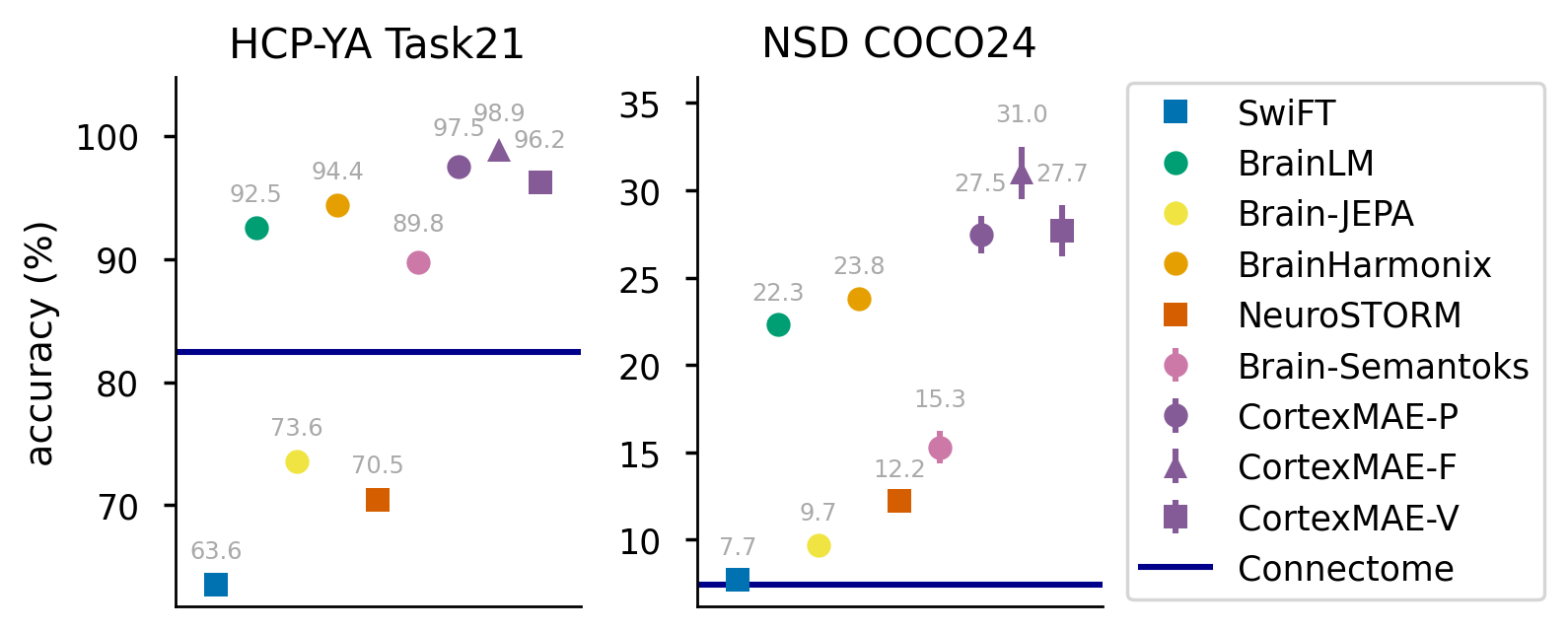
But importantly, this cross-subject decoding performance is much worse than what you can get by training subject-specific decoding models (>60% accuracy on NSD COCO24 image category decoding). There is a lot of room to explore how to adapt the current “population-level” fMRI FMs to take advantage of this fine-grained subject-specific information.
All fMRI foundation models struggle at clinical diagnosis
The ultimate goal of an fMRI foundation model is to help understand, diagnose, and treat brain and mental health conditions. A first step is to test whether models can distinguish between individuals with a clinical diagnosis (autism, Alzheimer's, etc.) and control subjects, solely using fMRI.
Surprisingly, we find that all fMRI foundation models (including our own) have relatively weak performance in this setting. Classification accuracy is inconsistent across models and datasets, and poorly differentiated from a simple baseline that uses hand-crafted functional connectivity features. (In contrast, the best models on state decoding are >20σ above baseline.)
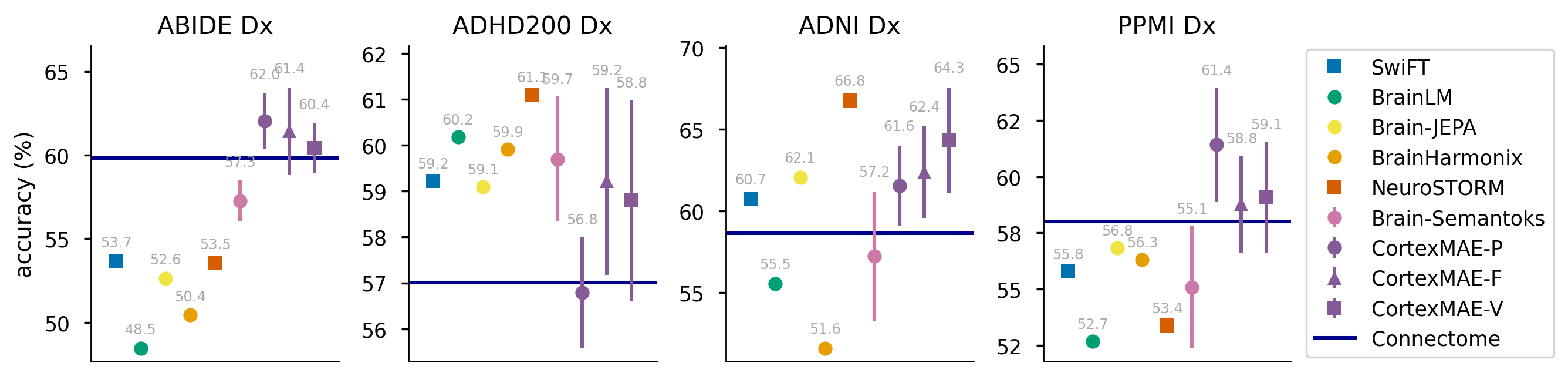
In order to clearly establish the clinical potential of fMRI foundation models, we think more informative benchmarks are needed. This means putting more effort into quality control for the current standard benchmarks, as well as building new benchmarks. One idea is to explore predicting clinically relevant changes in brain state (e.g. treatment response), rather than static traits like diagnosis category.
Scaling with data and compute
A crucial test of any foundation model approach is: Does it scale? Our answer is: yes, but we are limited by data. Masked reconstruction performance scales with increasing dataset size according to a strict power law.
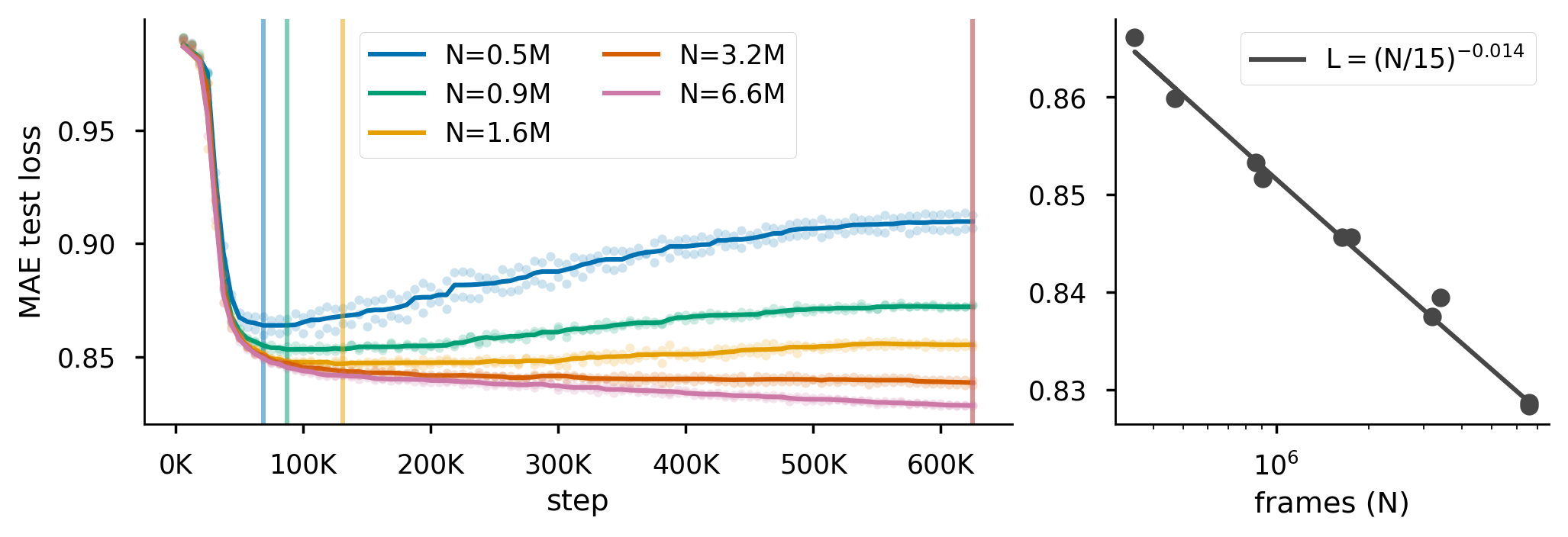
As we scale model size, however, performance saturates around 37M parameters. In the paper, we also show how even the strong data scaling trend becomes weaker when we test on out-of-distribution data from another dataset. These results suggest that fMRI foundation models need more data, and especially more diverse data.
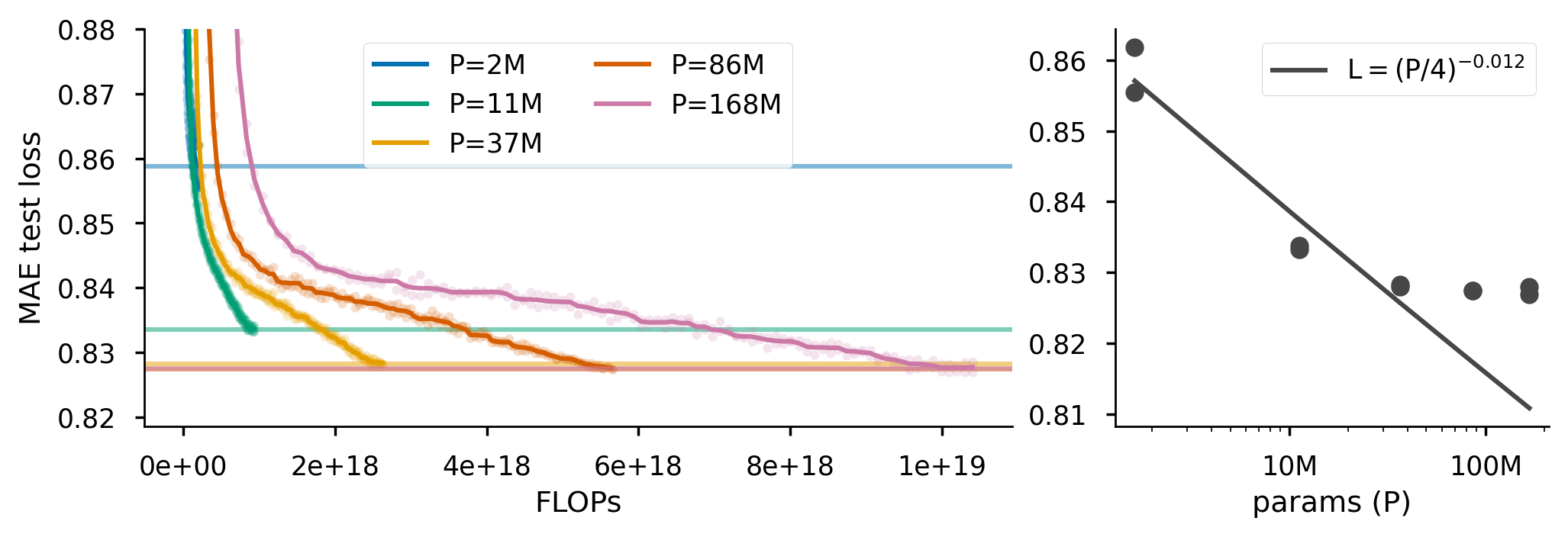
We should also recognize that fMRI “foundation models” still live in the toy regime (<100M parameters, <10B tokens) compared to modern vision and language models. There is a lot of room to scale these models up, if we can find the right data for it.
Conclusion
There are many more results in the main paper, check it out!
Looking ahead, we feel that the field of fMRI foundation models, and foundation models for neuro data more broadly, is still in its early stages. Our work leaves many future directions open. We are currently working on building multimodal MRI foundation models of brain structure as well as function. We are participating in the FOMO26 MRI foundation model challenge and our team is open to new contributors. Find us in the MedARC Discord!
We are also interested in working with academic researchers and commercial partners to build applications of our models . We made the models open so you can test them out yourself. To get started, check out our GitHub! Send us a message if you're interested in discussing more.